
Walk into any craft grower's barn and someone will eventually start talking about terpenes. The word gets used loosely — sometimes to describe aroma, sometimes to mean "the effect of the plant minus the main cannabinoid," sometimes just as marketing shorthand. None of that is wrong, exactly, but it obscures a more interesting picture. Terpenes are the same family of volatile compounds that make a pine forest smell like pine and a bag of fresh lemons smell like lemon. They are everywhere in the botanical world, and the research on their physiology is older, deeper, and more sober than the strain-menu version would suggest.
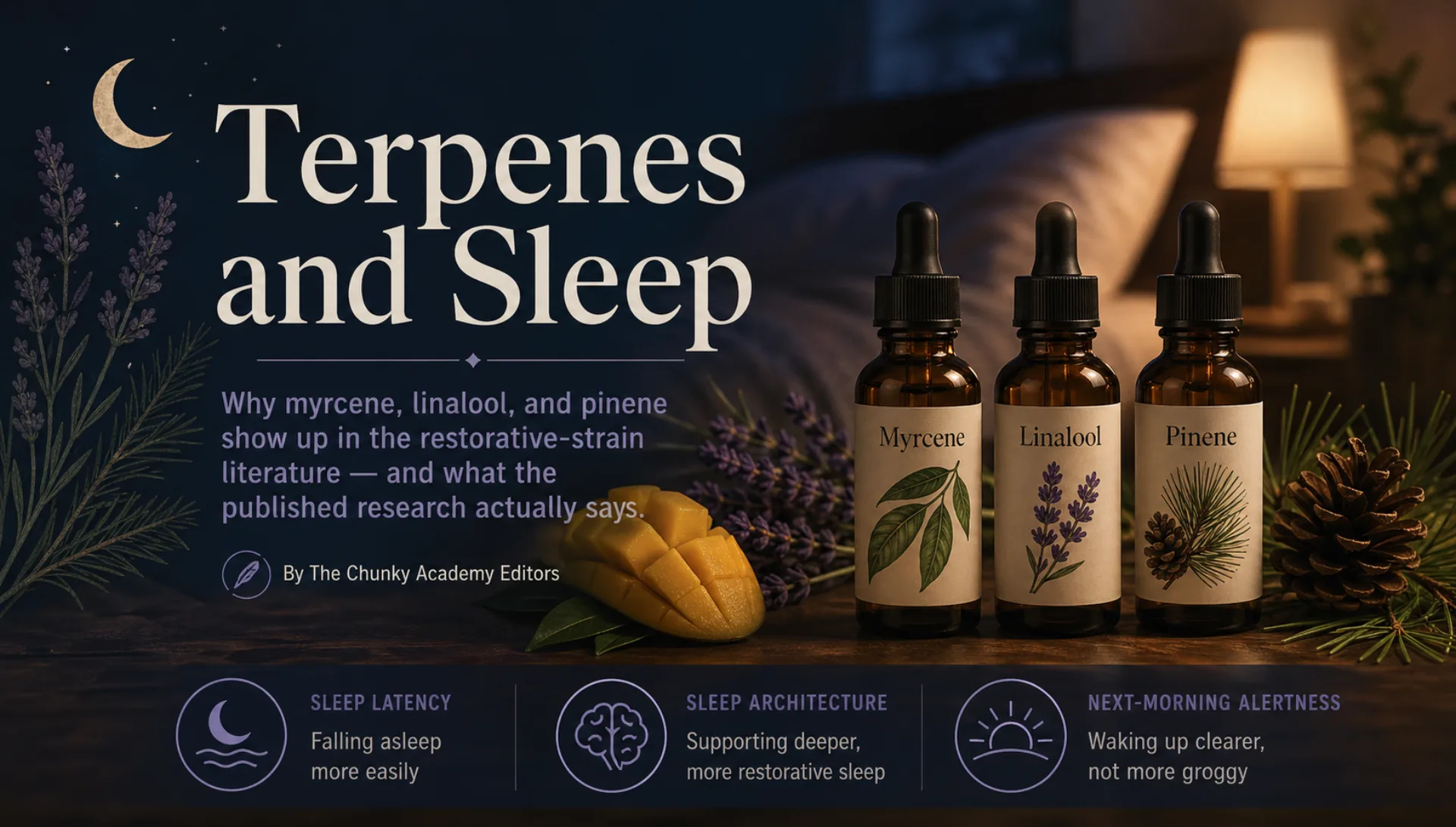
This essay narrows the scope to one question: what do we actually know about terpenes and sleep? It's the area where the folk-knowledge claims — "this one is sedating," "that one will knock you out" — intersect most directly with a measurable outcome (sleep latency, sleep architecture, next-morning alertness). We'll look at the three terpenes that show up most often in the sleep literature, what their proposed mechanisms are, and where the evidence gets wobbly.
Myrcene
Myrcene is the terpene most frequently associated with sedation in popular writing, and it's also one of the most abundant terpenes in hops, mango, lemongrass, and thyme. In rodent studies, myrcene has shown muscle-relaxant and mild sedative effects, often cited from the older work of do Vale et al. (2002) and others. The mechanism is not fully understood; candidates include positive modulation of GABA-A receptors and some direct smooth-muscle activity.
The gap between "measurable effect in mice at high doses" and "noticeable effect in humans at realistic exposures" is, as always, substantial. What the literature does support is that myrcene is pharmacologically active — not just an aroma molecule — and that the active doses in animal models are well-studied. What it does not yet support is a clean dose-response curve in human sleep trials.
Why it shows up on "sleep" lists
Growers and cultivators use myrcene concentration as a rough proxy for "heavy" or "couch-lock" profiles, because higher-myrcene samples have tended to correlate with that subjective profile in both informal and small-sample settings. This is a reasonable heuristic, but it is a heuristic. A high-myrcene chemotype sitting next to a high-CBG chemotype is not going to produce the same experience, even though both might be called "relaxing."
Linalool
Linalool is the terpene that gives lavender its smell. The sleep research on lavender itself is surprisingly extensive; a 2020 systematic review in the Journal of Alternative and Complementary Medicine identified multiple randomized trials using lavender oil aromatherapy as a non-pharmacological sleep aid, with small-to-moderate effects on sleep quality scales.
Whether the active ingredient in those trials is specifically linalool is harder to isolate. Lavender essential oil contains linalool alongside linalyl acetate and a long tail of minor constituents; the entourage problem exists in lavender research too. But linalool in isolation has shown anxiolytic and mild sedative properties in animal models through what appears to be GABAergic modulation, and at least some inhalation studies in humans show reduced cortisol and improved subjective calmness.
A reasonable summary: linalool is the terpene with the strongest single-compound case for a real sleep-adjacent effect, and the case is mostly built on the back of decades of lavender research rather than on studies done in the hemp literature.
Pinene
Pinene is the outlier on a "sleep terpenes" list. Most of its acute pharmacology is alerting, not sedating — there is interesting work on alpha-pinene as an acetylcholinesterase inhibitor, which would, all else equal, point toward improved attention rather than drowsiness. So why does it show up at all when people talk about restorative profiles?
The argument from experienced growers and from a handful of observational studies is that pinene may modify the experience of the whole plant in ways that are hard to reduce to a single mechanism — possibly by offsetting short-term memory effects, possibly by shifting the time course of the experience. The evidence here is genuinely thin, and honest writers should say so. Pinene belongs in a conversation about terpene diversity; it probably does not belong at the top of a "for sleep" list.
What we don't know
Three honest caveats close this out.
First, almost all of the single-compound mechanistic work is done at doses and via routes of administration that are very different from how people encounter these molecules in real life. Gavaging a rat with 200 mg/kg of isolated myrcene is not a model of inhaling a plant that contains 0.8% myrcene alongside forty other compounds.
Second, the entourage hypothesis — the idea that cannabinoids and terpenes modulate each other's effects — is plausible and partially supported, but it is also the most-invoked and least-proven claim in the popular literature. Treat it as a working model, not a conclusion.
Third, sleep is a notoriously difficult endpoint to study. Self-reported sleep quality is noisy. Actigraphy is better but still imperfect. Polysomnography is the gold standard and is rarely used in botanical trials because it is expensive. When somebody tells you a terpene profile "works," they may be describing a real pharmacological effect, a placebo effect, a bedtime-ritual effect, or some combination.
How we read the literature ourselves
When we look at lab reports and chemotype analyses, we read terpene panels the way a wine drinker reads a varietal label: informative, suggestive, not determinative. A chemotype dominated by myrcene and linalool with low pinene is a reasonable starting place if you're looking for a restorative profile. But the person, the context, the dose, and the setting matter at least as much as the chemistry.
That's less satisfying than a list of "best strains for sleep," and we think that's the honest version.